
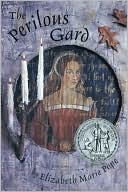
The Perilous Gard, by Elizabeth Marie Pope. Houghton Mifflin Harcourt, 2001, 288. Age/interest level 12-up.
Reading Level: Teens/Young Adults
Recommended for: Ages 15-18
Bottom line: The Perilous Gard combines a love story with issues central to Christianity and paganism, in a satisfying and thought-provoking read for teens.
Katherine Sutton serves as lady-in-waiting to Princess Elizabeth, sister of Queen Mary. Currently Elizabeth is locked away in dreary Hartford Castle by her paranoid sister. Kate has sister troubles too: through the meddling of her airhead sibling Alicia, Kate attracts the unwelcome attention of “Bloody” Mary and is banished to an even more remote location in central England. There she will abide under the watchful eye of Sir Geoffrey Heron in Perilous Gard (“Gard” being Old English for castle), deep in the uncleared forests of Elvenwood. Sir Geoffrey is courteous but remote; his younger brother Christopher is rude and even more remote (though better looking). The property is Sir Geoffrey’s by marriage, but he escapes from it at every opportunity due to unhappy memories. Kate slowly learns that the wood, the castle, and Christopher Heron are haunted–not by the dead, but by the living remnants of the ancient religion that once ruled all of England.
Though technically fantasy, The Perilous Gard could almost pass for historical fiction. It’s a riveting tale, once you get past the first couple of chapters, where the narrative leans heavily on description because the physical surroundings are so important to the story. Traces of the old druidic religion lingered in England up to Elizabethan times and beyond, as any close reader of Shakespeare knows. (C. S. Lewis also explored the phenomenon in That Hideous Strength.) Modern pagans don’t have a clue what the real thing was all about: nature-worship paired with blood sacrifice, mindless ecstasy ridden by fear, a relentless eye-for-eye accounting system that left no room for compassion. The “fairies”, as Ms. Pope presents them, are scrupulously just in their dealings with humans and any bargain struck they will keep, no matter the cost to anyone. But, as Kate perceives, humans don’t need justice from fairies: “We’re all of us under the mercy.” The Perilous Gard is not a “Christian novel” and makes no attempt to preach or proselytize. What the author achieves is a faithful representation of a spiritual clash, refreshing in that Christians are not automatically cast as stodgy, repressive meanies. In fact, they seem to be the good guys. It’s also an engaging , PG-rated romance that girls 12 and older will swoon for. Originally published in 1974, the paperback edition is readily available and includes illustrations by Richard Cuffari (that that don’t add much, in my opinion).
Cautions: Supernatural (practitioners of paganism, but shown in an unfavorable light)
Overall Value: 5 (out of 5)
- Moral/Worldview Value: 5
- Artistic Value: 4
<iframe sandbox="allow-popups allow-scripts allow-modals allow-forms allow-same-origin" style="width:120px;height:240px;" marginwidth="0" marginheight="0" scrolling="no" frameborder="0" src="//ws-na.amazon-adsystem.com/widgets/q?ServiceVersion=20070822&OneJS=1&Operation=GetAdHtml&MarketPlace=US&source=ss&ref=as_ss_li_til&ad_type=product_link&tracking_id=redeemedreade-20&language=en_US&marketplace=amazon®ion=US&placement=0618150730&asins=0618150730&linkId=9f1aea5c69dc27169f85ba7aacdfa867&show_border=true&link_opens_in_new_window=true"></iframe>*Discussion Questions:
- Literary Element: Would you classify this book as historical fiction or fantasy? Why?
- Thematic Element: What sacrifices are Christopher and Kate called upon to make? Are they both equally effective?
- Worldview Element: How does Christianity compare with paganism in this story? What is the main appeal of each?
Stay Up to Date!
Get the information you need to make wise choices about books for your children and teens.
Our weekly newsletter includes our latest reviews, related links from around the web, a featured book list, book trivia, and more. We never sell your information. You may unsubscribe at any time.
Support our writers and help keep Redeemed Reader ad-free by joining the Redeemed Reader Fellowship.
Stay Up to Date!
Get the information you need to make wise choices about books for your children and teens.
Our weekly newsletter includes our latest reviews, related links from around the web, a featured book list, book trivia, and more. We never sell your information. You may unsubscribe at any time.
FREE Bible Guide!
Get a guide to the Best Bibles for Children and Teens. Perfect for an Easter gift.

We'd love to hear from you!
Our comments are now limited to our members (both Silver and Golden Key). Members, you just need to log in with your normal log-in credentials!
Not a member yet? You can join the Silver Key ($2.99/month) for a free 2-week trial. Cancel at any time. Find out more about membership here.
2 Comments
Leave a Comment
You must be logged in to post a comment.
I just put this on my hold list from the library. Thanks!
I’ve loved this book for many years and have just re-read it over the past few days. I don’t see a contrast being made between the “Fairy Folk”‘s religion and Christianity, so much as between them and the everyday, aboveground folk, including culture, laws, and behavior. Kate mentions Christianity a couple of times, of course, but the issue is never emphasized or followed at any length.
And speaking to the wording of the question here as relating to modern readers: This paganism is a fictional creation, and in particular is entirely unlike that of modern pagan religions.