
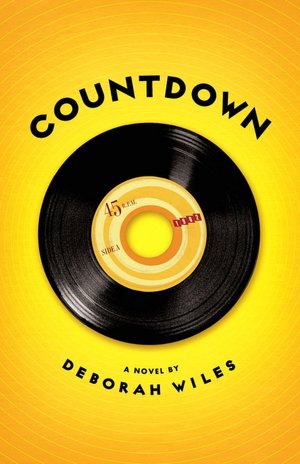
 Countdown (the Sixties Trilogy) by Deborah wiles. Scholastic, 2010, 377 pages.
Reading Level: Middle grades, ages 10-12
Maturity Level: 4 (ages 10-12) and up
Bottom Line: Countdown takes middle-grade readers back to the Cuban missile crisis, as 11-year-old Franny Chapman deals with the fear of events spinning out of control.
To Franny Chapman, whose father is an air force officer in the Pentagon, the crisis announced by President Kennedy is immediate and relevant, and shadows her life for the next two weeks. Playing out against events of global import are the ups and downs of middle-gradehood: a difficult uncle and his unfortunate obsessions, worries about her siblings (her sister becoming a campus radical, her little brother quirky and fearful), the cute neighbor boy who moved back—and may like her!—and a nuclear falling-out with her best friend. The latter brings on a personal crisis, at the same time a national emergency is building. Both grownups and kids are frightened, and Uncle Otis is digging a bomb shelter in the backyard, just in case they have to use it.
The setting is October 1962 in northern Virginia, but Franny’s dilemma is one we all have to face sooner or later: How do we deal with worries that are totally out of our control? I remember hiding under my desk during air-raid drills at school and exploring model bomb shelters at the state fair, so the Cold War doesn’t seem like “history” to me. It’s worth knowing about for two reasons: first, it was the last “war” we actually won, and second, it’s an example of how peace through strength can actually work. That’s not necessarily the takeaway for Franny, but she gets some good advice from her sister the budding radical: “There are always wonderful things happening in the world. There are always wonderful things happening. And it’s up to you to decide how you’re going to approach the world . . . how you’re going to live in it, and what you’re going to do.”
The book designers try to create a period feel with documentary-style collages between chapters: song lyrics, speech fragments, headlines, news photos, magazine layouts of fashion and home decorating, etc. These may be more confusing than enlightening to young readers, but they’ll send grandmas on a quick trip down memory lane. Politically it slants (in an unobtrusive way) to the left, but in the end Franny’s conclusion is full-bodied and positive and hints at a divine power in control of it all: “The earth is the Lord’s, and the fullness thereof/the world,/and they that dwell therein.”
Also by this author: Revolution.
Cautions: none
Overall rating: 4 (out of 5)
- Worldview/Moral value: 4
- Artistic Value: 4
Categories: Middle Grades, Historical Fiction, American History, War, Life Issues
Stay Up to Date!
Get the information you need to make wise choices about books for your children and teens.
Our weekly newsletter includes our latest reviews, related links from around the web, a featured book list, book trivia, and more. We never sell your information. You may unsubscribe at any time.
Support our writers and help keep Redeemed Reader ad-free by joining the Redeemed Reader Fellowship.
Stay Up to Date!
Get the information you need to make wise choices about books for your children and teens.
Our weekly newsletter includes our latest reviews, related links from around the web, a featured book list, book trivia, and more. We never sell your information. You may unsubscribe at any time.
FREE Bible Guide!
Get a guide to the Best Bibles for Children and Teens. Perfect for an Easter gift.

We'd love to hear from you!
Our comments are now limited to our members (both Silver and Golden Key). Members, you just need to log in with your normal log-in credentials!
Not a member yet? You can join the Silver Key ($2.99/month) for a free 2-week trial. Cancel at any time. Find out more about membership here.
5 Comments
Leave a Comment
You must be logged in to post a comment.
Thank you for the reviews; I’ve enjoyed reading them, and I really love the site’s new look!
Thanks, Hayley! So nice to hear some positive feedback. (It’s my favorite kind!) After four months of work, we’ve still got some tweaking to do, but it’s getting there. : )
Pardon my ignorance, but what does “Worldview/Moral value: a4” mean? I would like to use this book for my fifth graders to get them engaged with our teaching of the Cuban Missile Crisis. I have used this book in the past, but now it needs to go through a “vetting” process and I wasn’t sure what this terminology meant. Thank you in advance.
Robin,
Thanks for asking! You’ll find a detailed description of our ratings and what they mean here: https://redeemedreader.com/our-ratings/
Robin, are you wondering if “a4” means something different than 4? Just checking to be sure. I’ve corrected the typo in the post (it should just be a “4” rating). Otherwise, the link Janie provided should answer your question.